


Building a Data Warehouse for SEN Education
Integrating Mood, Behaviour, Academics, and Calming Strategies
Introduction
Special Educational Needs (SEN) education requires an understanding of the whole child, including academic progress, emotional wellbeing, behaviour, and self-regulation. In many settings this information is collected daily by teachers, therapists, and support staff, but it is often fragmented across systems or recorded informally.
A purpose built data warehouse can bring these data sources together, supporting personalised education, early intervention, and evidence based decision making.
Seeing the Bigger Picture in SEN Education
SEN data differs from traditional educational data because it is highly individual, time sensitive, and strongly influenced by emotional states. A data warehouse supports:
- A holistic view of each child
- Identification of emotional and behavioural patterns
- Evaluation of calming and intervention strategies
- Collaboration between educators, therapists, and families
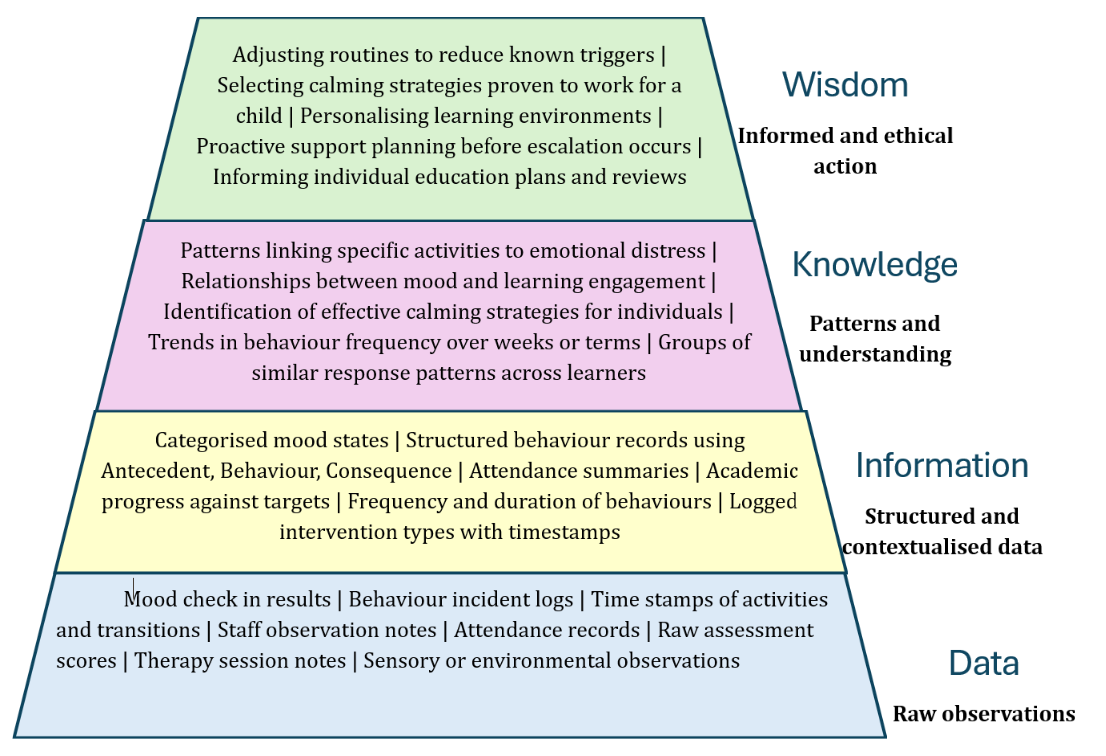
The DIKW Pyramid shows how raw educational data becomes understanding and informed action. In SEN education this progression is especially important because data is often subjective, contextual, and deeply individual.
From Observation to Insight
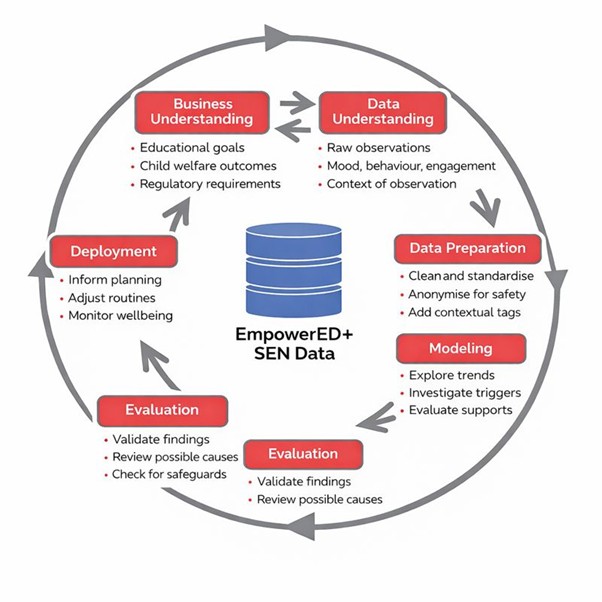
The EmpowerED+ system applies the CRISP DM process to transform SEN data into meaningful insight in a safe and ethical way. Educational and wellbeing goals guide data understanding, preparation, and modelling, where mood, behaviour, and engagement data are cleaned, contextualised, and analysed to identify patterns and effective supports. Findings are carefully evaluated with professional judgement and safeguarding in mind, then deployed to inform planning and monitor wellbeing in a continuous, iterative cycle.
How the Data System Works
Collecting and Preparing Information
Information is collected from everyday activities such as staff observations, learning activities, and support sessions. This might include notes about mood, behaviour, engagement, and what support was used.
Before anything is analysed, the information is carefully checked. It is cleaned to remove errors, made consistent so it means the same thing everywhere, and anonymised where needed. Important context, such as time of day or type of activity, is added so observations are understood properly. Only safe and reliable information is used.
The Data Warehouse
All prepared information is stored in one secure place called a data warehouse. You can think of this as a well organised library where information is kept in a clear and consistent way.
This makes it possible to:
- Look at progress over time
- See patterns rather than isolated events
- Support planning using evidence
- Share consistent information with professionals
Data Marts
To avoid information overload, smaller sections of the data are created for specific purposes. These are called data marts.
Examples include:
- Emotional wellbeing and mood
- Behaviour and self regulation
- Learning and engagement
- Support strategies and what helps
This means staff see only the information they need, in a clear and simple way.
Understanding Patterns and Trends (Models)
The system uses simple tools to help notice patterns and trends. These tools do not make decisions on their own and do not label children.
Examples include:
- Looking at how mood or engagement changes over time
- Noticing situations where a child may find things more difficult
- Comparing which calming or support strategies have helped in the past
- Spotting early signs that a child may need extra support
These tools help adults ask better questions and plan support more carefully. Professional judgement and knowledge of the child always come first.
How Everything Fits Together
- Information is collected and carefully prepared
- It is stored securely and clearly
- Smaller views make it easy to understand
- Simple tools help adults notice patterns
The aim is to support understanding, not to judge or label. Data is used to help children feel safer, calmer, and more supported in their learning and development.
Safeguarding and Data Protection
When working with information about children with Special Educational Needs, safeguarding and data protection are essential. Any data system used in education must comply with UK data protection legislation, including the UK GDPR and the Data Protection Act 2018.
Information is collected only where there is a clear educational or wellbeing purpose. Personal details are protected through anonymisation or restricted access, and only staff with an appropriate role are able to view sensitive information. Data is stored securely, access is logged, and information is retained only for as long as it is needed.
Most importantly, data is used to support children, not to label, profile, or penalise them. Professional judgement, safeguarding responsibilities, and the best interests of the child always come before data or technology.